
성장기록지
백준 21608 상어 초등학교 본문
문제
문제가 길다..
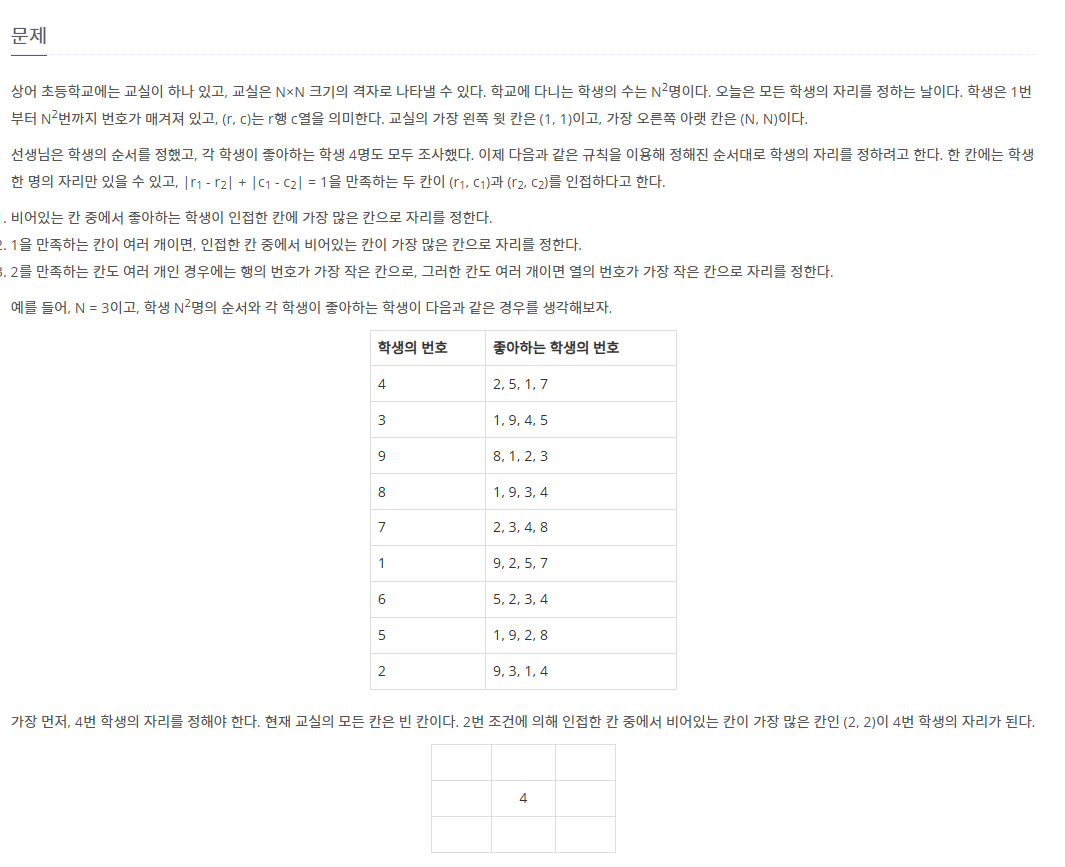
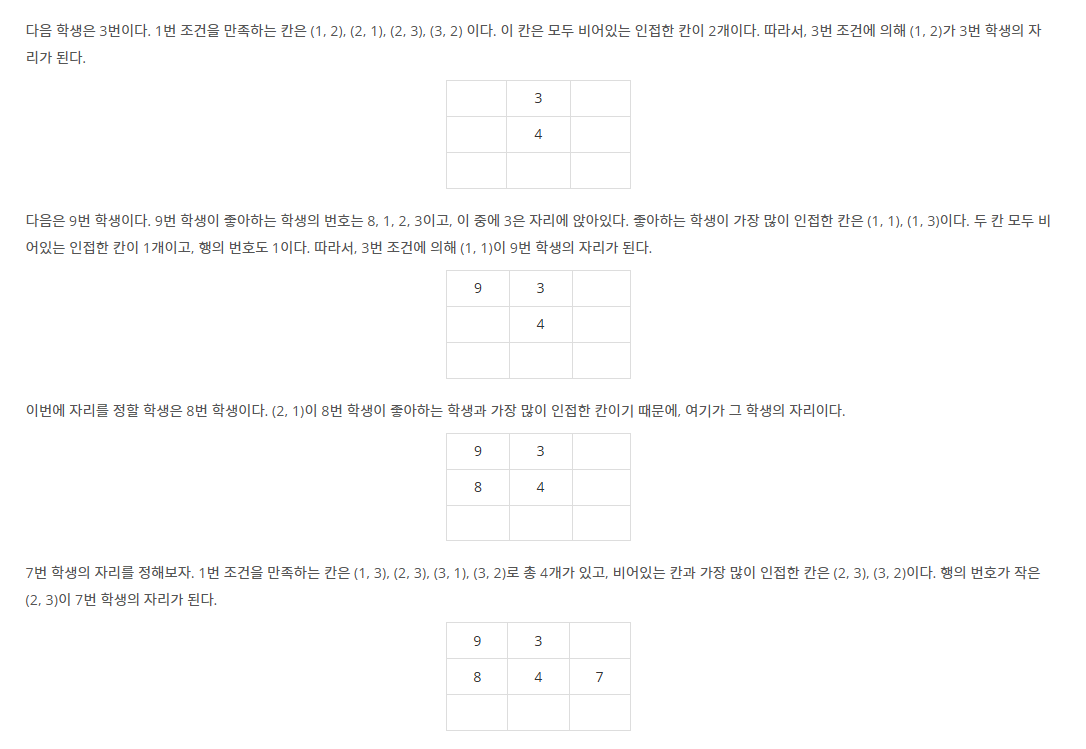

풀이
- 교실 초기화
- N×N 크기의 배열을 만들고, 배열의 바깥쪽을 -1로 채운다.
- 이렇게 하면 인덱스 범위를 벗어나지 않고 편리하게 탐색할 수 있다.
- 학생 배치 규칙
- 학생을 한 명씩 배치하면서 다음의 조건을 만족하는 자리를 찾는다.
- 좋아하는 친구가 인접한 자리
- 주변 네 방향을 확인하여 좋아하는 친구가 가장 많이 있는 자리를 찾는다.
- 비어 있는 칸이 많은 자리
- 1번 조건을 만족하는 자리 중에서, 주변 네 방향에 비어 있는 칸이 가장 많은 자리를 선택한다.
- 행과 열의 위치 기준
- 2번 조건까지 만족하는 자리 중에서, 행 번호가 작은 곳, 행이 같다면 열 번호가 작은 곳을 선택한다.
- 만족도 계산
- 모든 학생이 배치된 후, 만족도를 계산한다.
- 인접한 네 방향에 좋아하는 친구가 몇 명 있는지 확인하여 점수를 부여한다.
- 1명 → 1점
- 2명 → 10점
- 3명 → 100점
- 4명 → 1000점
구현 방법
- make_border(N, arr)
- 교실의 바깥쪽을 -1로 채운다.
- first_check(N, arr, student)
- 좋아하는 친구가 가장 많은 자리를 찾는다.
- second_check(arr, check_one)
- 1번 조건을 만족하는 자리 중에서, 주변의 빈 칸이 가장 많은 자리를 찾는다.
- third_check(arr, check_two)
- 2번 조건까지 만족하는 자리 중에서, 행과 열의 기준을 따져 최종적으로 앉을 자리를 결정한다.
- cal_score(N, students, arr)
- 배치가 끝난 후, 만족도를 계산한다.
코드 (수정-마법사 상어와 비바라기 코드로 잘못 넣었다..)
#상 하 좌 우
dx = [-1,1,0,0]
dy = [0,0,-1,1]
#배열 가로 세로
N=int(input())
#학생 리스트 생성
students = [list(map(int,input().split())) for  _ in range(N**2)]

#자리 리스트 생성 -> N+2만큼
arr=[[0 for _ in range(N+2)] for _ in range(N+2)]

#외곽은 -1로
def make_border(N, arr):
    for i in range(N+2):
        arr[0][i]=-1
        arr[N+1][i]=-1
        arr[i][0]=-1
        arr[i][N+1]=-1

make_border(N, arr)


#1번조건 -> 좋아하는 친구 찾기, 함수로 추출 할것
def first_check(N, arr, student):
    friends=0
    max_one=0
    check_one=[]
    for i in range(1,N+1):
        for j in range(1,N+1):
            if arr[i][j]==0:
                for k in range(4):
                    if arr[i+dx[k]][j+dy[k]] in student:
                        friends+=1
                #같으면 추가, 최대면 다 삭제하고 추가.
                if friends==max_one:
                    check_one.append([i,j])
                elif friends>max_one:
                    check_one=[[i,j]]
                    max_one=friends
                #친구 수 초기화
                friends=0
    return check_one

def second_check(arr,check_one):
    max_two=0
    check_two=[]
    zero=0
    for i in check_one:
        for k in range(4):
            if arr[i[0]+dx[k]][i[1]+dy[k]]==0:
                zero+=1
        if zero==max_two:
            check_two.append([i[0],i[1]])
        elif zero>max_two:
            check_two=[[i[0],i[1]]]
            max_two=zero
        zero=0
    return check_two

def third_check(arr, check_two):
    check_three = sorted(check_two, key = lambda x : (x[0],x[1]))
    for i in range(len(check_three)):
        if arr[check_three[i][0]][check_three[i][1]]==0:
            ans = check_three[i]
            return ans


def cal_score(N, students, arr):
    score=0
    ans_friends=0
    for i in range(1,N+1):
        for j in range(1,N+1):
            for student in students:
                if student[0]==arr[i][j]:
                    for k in range(4):
                        if arr[i+dx[k]][j+dy[k]] in student:
                            ans_friends+=1
                    if ans_friends==1: score+=1
                    elif ans_friends==2: score+=10
                    elif ans_friends==3: score+=100
                    elif ans_friends==4: score+=1000
                    ans_friends=0
    return score

for student in students:
    ans=[]
    check_one=[]
    check_two=[]
    check_one = first_check(N, arr, student)
    #1번의 정답이 하나면 그대로 정답에 넣어줌
    if len(check_one)==1:
        ans=check_one[0]

    #1번의 정답이 여러개면 2번조건 실행
    elif len(check_one)>1:
        check_two = second_check(arr, check_one)

    #2번의 정답이 하나면 그대로 정답에 넣어줌
    if len(check_two)==1:
        ans=check_two[0]

    #2번의 정답이 여러개면 3번조건 실행->
    elif len(check_two)>1:
        ans = third_check(arr, check_two)
    #정답의 배열에 학생을 넣어줌
    arr[ans[0]][ans[1]]=student[0]


score=cal_score(N, students, arr)
print(score)'알고리즘' 카테고리의 다른 글
| 백준 9934 완전 이진 트리 (python) (1) | 2025.01.16 |
|---|---|
| 백준) 2636 치즈 문제풀이 및 set() 활용 (2) | 2024.06.03 |
| 백준 1213) 팰린드롬 만들기 정리 (python) (3) | 2024.05.31 |
| 클린 구현 프로젝트 2) 백준 16926 배열 돌리기 (2) | 2024.05.24 |
| 깔끔하게 구현하기 프로젝트) 백준 17413 단어 뒤집기 2 (1) | 2024.05.13 |
'알고리즘' Related Articles
more


